

The outage was dismissed by some as nothing more than an inconvenience and labelled by others as merely annoying, but for people who understand the systems that underpin Australia’s digital economy, the Cloudflare failure was neither minor nor forgettable; it was a moment that revealed, in an instant, just how exposed the nation is, because Cloudflare is not a social network, a streaming service, or even a platform most people actively sign up for, yet when it failed, the internet failed with it — and so did Australia — raising an unavoidable question: if Cloudflare now functions as critical infrastructure in practice, shouldn’t it also be regulated and protected as critical infrastructure in law?
Cloudflare was never meant to be the backbone of Australia’s internet : Cloudflare Outage Perth

Originally designed as a tool for DDoS mitigation and CDN acceleration, Cloudflare has, over time, evolved into something far more foundational — a kind of global digital plumbing system — because as organisations shifted more and more of their websites, APIs, authentication layers and DNS operations into outsourced cloud environments, Cloudflare effectively transitioned from being a helpful service to becoming a core dependency, and now sits as an intermediary between Australian banks and their customers, Perth Airport’s passenger processing systems, retail checkout APIs, media outlets, government portals, healthcare platforms, AI inference systems, and countless login and authentication services, which means Cloudflare is, in practice, part of Australia’s critical infrastructure rather than simply another technology vendor.
Table: Types of Australian services affected by Cloudflare failure
This is what happens when the core of the internet becomes privatised.
The Cloudflare outage wasn’t the problem — Cloudflare Outage Perth

The outage lasted only a few hours, no lives were lost, and Perth quickly returned to normal, but the incident raises a more serious question about what would happen if a similar failure lasted twelve hours or occurred during a national emergency, because Australia currently has no sovereign fallback, no backup CDN, no emergency routing layer and no public-grade local redundancy, prompting one cyber-policy researcher to note that “we’re treating foreign service providers like public utilities, but without the regulation, oversight or emergency protocol of a real utility.”
The illusion of sovereignty — Cloudflare Outage Perth
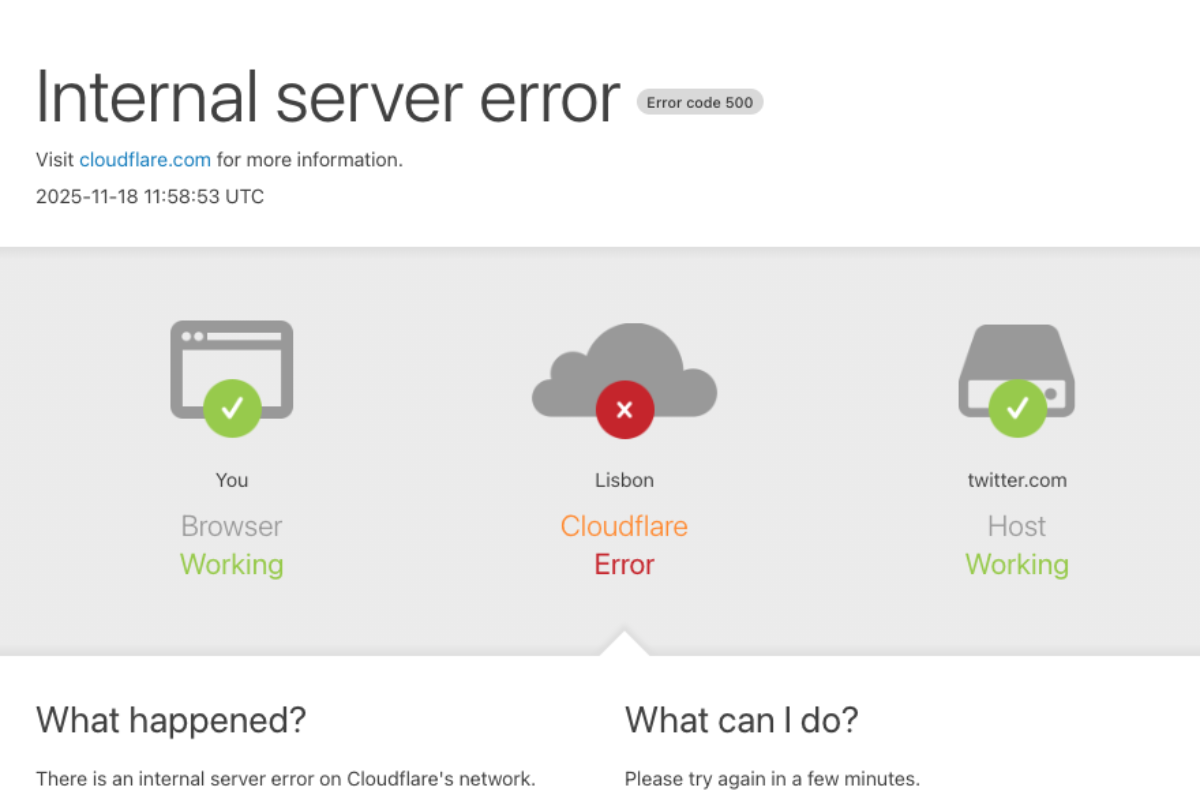
Canberra talks about “digital sovereignty” and “strategic capability,” but what sovereignty exists if a configuration mistake in San Francisco can affect passengers at Perth Airport?
Perth’s distance from Australia’s east-coast infrastructure makes it the first casualty when global systems buckle — and the perfect case study for what governance failure looks like.
When corporations become utilities :Cloudflare Outage Perth
Companies like Cloudflare, AWS and Azure now operate as de facto infrastructure in Australia:
- They are not regulated as critical utilities
- They are not required to provide redundancy
- They are not required to notify the public
- They are not bound by Australian continuity standards
- They do not report disruption KPIs like power or water companies
Yet the economy depends on them in exactly the same way.
That is a structural failure — and a policy vacuum.
Australia keeps getting warnings (Cloudflare Outage Perth)
We have already seen these failures:
Each time:
- Companies apologise
- Government “reviews”
- Public moves on
- Nothing changes
This is not bad luck.
This is systemic negligence.
What the next outage could look like

A truly catastrophic Cloudflare failure could break:
⚠️ Banking authorisation
⚠️ Public health portals
⚠️ Cloud-hosted medical devices
⚠️ Retail & logistics supply chains
⚠️ Airport scheduling & safety comms
⚠️ Government messaging
⚠️ Emergency service web-based reporting
That is not hypothetical.
That is already structurally possible.
The Cloudflare outage exposed a reality Australia has been avoiding for years — that we do not truly own our digital infrastructure but merely rent access to it, often without any meaningful contractual control, and until companies like Cloudflare, Amazon and other backbone providers are regulated with the same obligations and safeguards as public utilities, Australians will continue to function as passengers inside a system they cannot steer, making this outage a warning of what could come, and the next outage a potential national crisis.


