

This Monday Night Football analysis approaches the 49ers–Panthers matchup from an explainer perspective, focusing on how the game operated rather than simply retelling events. The 49ers (7–4) entered looking for stability at home, while the Panthers (6–5) arrived with three straight road victories and a growing belief they could push into the NFC playoff picture.
With Christian McCaffrey facing his former team, the emotional layer was obvious, but this game quickly became a study in decision-making, drive structure, and red-zone outcomes. What unfolded was less about explosive plays and more about the mechanics behind each team’s approach.
How Purdy’s Turnovers Altered the Flow — and Why Carolina Couldn’t Convert Them
Brock Purdy’s first-half difficulties were not simply mistakes; they changed the entire structure of San Francisco’s offense. His opening throw — intercepted by Jaycee Horn — disrupted the rhythm Kyle Shanahan attempted to establish. A deep ball picked by Mike Jackson and a second misread grabbed by Horn accelerated the pressure on San Francisco.
A Look at How Each Turnover Affected Game Flow
| Sequence | Event | Resulting Panthers Drive | Outcome |
|---|---|---|---|
| INT #1 | Jaycee Horn jumps first play | Starts at midfield | Field goal only |
| INT #2 | Deep shot picked by Mike Jackson | Enters red zone | Drive stalls at SF 4 |
| INT #3 | Horn’s second takeaway | Prime scoring chance | Young INT to Ji’Ayir Brown |
Carolina’s failure to turn these into touchdowns shifted the game’s trajectory. Examples included:
- A miscommunication on a third-down out-route with Tetairoa McMillan resulting in a drop
- Intentional grounding after protection collapsed on an early red-zone snap
- A fade from Bryce Young that hung too long, allowing Ji’Ayir Brown to make an uncontested interception
In a format sense: Purdy provided openings, but Carolina didn’t follow the sequence required to convert short fields into points.
How McCaffrey Became the Structural Fix for San Francisco’s Offense – Monday Night Football analysis

Christian McCaffrey served as the stabilizing mechanism that allowed the 49ers to reset their offensive structure. His 31 touches for 142 yards weren’t about volume alone — they reflected a game plan built around controlling pace and lowering risk once Purdy’s early reads faltered.
The clearest example was the 13-play, 80-yard touchdown drive in the third quarter. From an explainer standpoint, this drive worked because it followed a predictable but effective formula:
- Horizontal movement to stress Carolina’s linebackers
- Early down runs to simplify second and third downs
- Interior pull-blocks that created clean vision lanes
McCaffrey’s 12-yard touchdown run was a direct result of that sequencing. It moved the game from unstable to controlled, giving the 49ers the structural foundation they lacked in the first half.
Why the 49ers’ Defensive Framework Held — and How Carolina’s Rookies Fit Into the Picture – Monday Night Football analysis
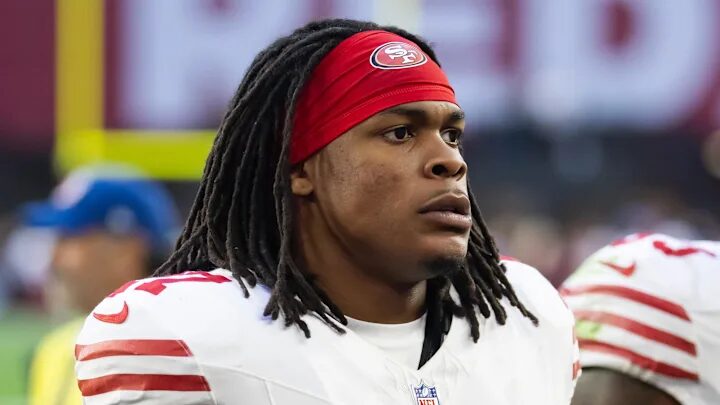
San Francisco’s defensive success can be explained by their ability to hold structure even without Fred Warner. Ji’Ayir Brown’s two interceptions showcased disciplined safety play, reading Young’s eyes and closing space before routes fully developed. Luke Farrell’s timely pressure helped collapse several key downs.
The “bend-but-don’t-break” description fits because the 49ers repeatedly allowed early movement but tightened inside the 25-yard line. Carolina’s nine total points — all off turnovers — reflect that structure.
On the other side of the ball, Carolina’s rookies offered examples of developing roles:
- Tetairoa McMillan’s 29-yard touchdown showed improved route pacing after earlier inconsistencies
- Rico Dowdle’s early explosiveness provided a functional outlet when pressure increased
- Bryce Young’s 18/29, 169 yards, 1 TD, 2 INT revealed the balance between growth and continued decision challenges
Explainer takeaway: Carolina had functional pieces but lacked the layered execution required to break San Francisco’s structure.
Late-Game Management, Injuries, and How These Situational Factors Shaped the Outcome – Monday Night Football analysis
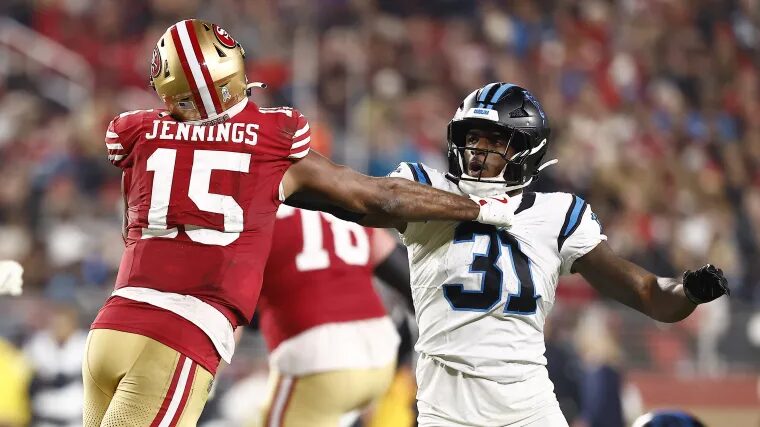
Situational football often explains as much as headline plays, and that held true here. Jaycee Horn, who provided two early interceptions, left with a concussion, which altered how Carolina shaded coverage in the second half. A brief postgame exchange between Jauan Jennings and Moehrig added emotional context but did not alter the game’s structural flow.
San Francisco navigated without Brandon Aiyuk, effectively simplifying their offensive tree. Emergency kicker Matt Gay played without issue, preserving field-goal stability. Meanwhile, Robinson’s first NFL start offered a developmental angle for Carolina.
In the standings:
- The 49ers improved to 8–4, gaining valuable conference leverage
- The Panthers fell to 6–6, missing the structural advantage that early turnovers should have created
From a format perspective: execution gaps, not schematic limitations, explain the Panthers’ missed opportunity.
Conclusion — What This MNF Game Teaches About Both Teams Moving Forward
This Monday Night Football analysis highlights a deeper truth beneath the score: the 49ers survived because their structure held under pressure, not because their offense executed at peak level. McCaffrey’s workload created stability, while the defense prevented Carolina from capitalizing on short fields.
The Panthers showed competitive flashes, but their inability to complete sequences — drives, reads, and red-zone possessions — kept them from turning opportunity into control. Both teams remain viable playoff threats, but both walk away knowing that structural improvement will define their December path.


